
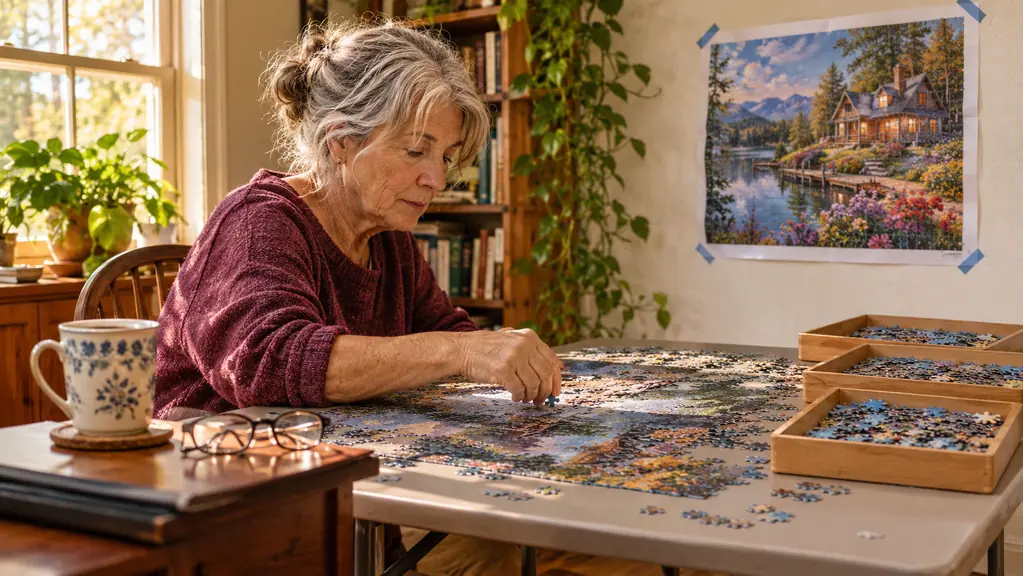
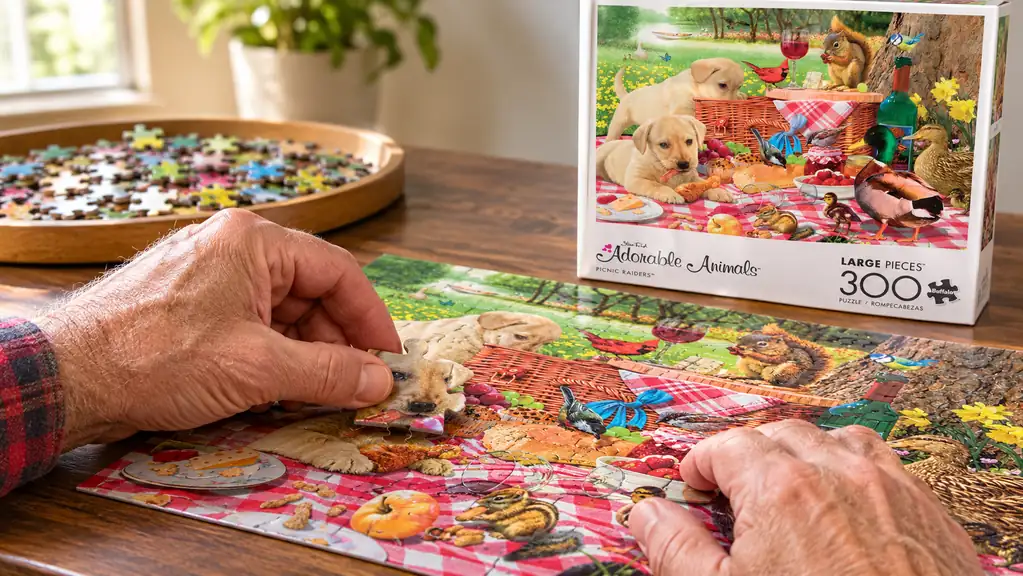
My mother is 88 and her hands are not what they were. Mild arthritis, mostly at the base of the thumbs, and that is enough to turn a standard thousand-piece jigsaw into a bad afternoon. The pieces are small, they slide, and lifting one off a flat table means pinching it against the surface, which is the exact motion her hands have quietly stopped doing. So when my kids asked what to get her, I said a jigsaw, and then I said the part that keeps me out of trouble: not the usual kind. We landed on the Buffalo Games Picnic Raiders, 300 large pieces, and then spent the next month learning how to use it properly. The puzzle turned out to be the easy part. The setup is what decides whether it ever gets finished.
Here is what I mean. Open the box on a low coffee table with a lamp behind you and the whole thing dies in fifteen minutes. Set it up on a card table with trays, a decent light and the poster taped to the wall, and suddenly it is an hour of company and a reason to get dressed. Buffalo Games did their part: the pieces are sized so they can be seen and picked up, and the box includes a large reference diagram. The rest is on us. These are the five steps we settled into. None of them cost much, none of them need an app, and none of them end with my mother calling me because she cannot get started.
Pieces big enough to pick up without pinching
Buffalo Games Picnic Raiders is 300 large pieces with a full-size reference poster in the box. 4.7 stars from more than 5,100 reviewers, plenty of them setting it up for a parent. See today's price.
Amazon Check Today's Price on Amazon →Step 1: Fix the table before you open the box
The first step has nothing to do with puzzles. It is about the table. A dining table is usually the wrong height and covered in a cloth, and cloth is the enemy, because a piece on cloth cannot be slid into place, it has to be lifted. We use a folding card table, set so the surface sits just below my mother's elbows when she is seated. That one measurement did more for her hands than anything else in this article. When the table is too low she leans forward, her shoulders round, and after ten minutes her neck is the problem instead of her thumbs.
Then the trays. I bought three shallow rimmed baking sheets at a kitchen store, the kind with a half-inch lip, and they cost less than lunch for two. One holds edge pieces, one holds pieces sorted by picture, one holds the box lid and the poster. The lip matters more than it sounds like it would: a piece pushed to the edge of a rimmed tray stops, and a piece pushed to the edge of a flat table falls on the floor. My mother has not chased a piece under the radiator since we made the switch. A rimmed tray also lets her stir the pieces with two fingers instead of picking through them one at a time.
Keep the box nearby. It weighs eight ounces empty, so it is no burden to store, and the picture on the front is still useful after the poster goes up. We park it on a side table with the lid propped against the wall. If the table has to be cleared for dinner, the whole project moves in one trip: box, three trays, poster. Nothing is glued down, nothing is heavy, and nothing needs a second person. That portability is the reason this puzzle gets used on a Tuesday in February and not just on Christmas morning.
Step 2: Read the poster, not the box lid
Buffalo Games puts a large reference diagram in the box along with the puzzle, and most people leave it in there. Do not. The lid picture is small and the poster is not, and for anyone whose eyes are also 88 years old, that difference is the whole game. We tape the poster to the wall at the end of the table, at eye level when she is seated, so checking a detail is a glance instead of a lean. Leaning is what makes her hands tired. Glancing does not.
Spend five minutes with the poster before you touch a single piece. Picnic Raiders is a busy scene: puppies, a few squirrels up to no good, birds, and a lot of small summer detail. Busy is good here. A scene with fifty small distinct objects gives you fifty places to start, and starting is the thing that stalls people. Point out three specific things she might hunt for, a particular puppy's ear, a bird on a branch, the edge of a picnic basket, and let her go find them. That is a far better first ten minutes than staring at a table of loose pieces waiting to feel ready.
Step 3: Sort by picture first, shape second
Most people sort by shape. Sort by picture first. Shape sorting is a fine skill and it is also the slowest possible way to begin, because you handle every piece twice. Instead, pull out anything with grass on it, anything with sky, anything clearly part of a dog, and lay them face up in the trays. Face up matters. A tray of face-down pieces is a second sorting job you created for yourself. Once the picture piles are made, the puzzle has shrunk from three hundred pieces to six small projects, and six small projects is not intimidating to anybody.
The pieces are paper on premium board, sturdy enough to take real handling, and the size means a piece can be nudged with the side of a finger rather than pinched. That is the whole reason this puzzle works for arthritic hands. My mother cannot do a fine pincer grip for an hour, but she can push a large piece into place with a thumb and a forefinger, and she can slide it the last quarter inch along the table. Large pieces are not a compromise for her. They are the only version of this activity she gets to keep.
One warning, from experience. Paper pieces and a sweating glass of iced tea are not friends. Drinks go on the side table, not the puzzle table, and we keep a dry dish towel folded nearby for hands. If a piece does get damp, let it dry flat and away from heat rather than pressing it, and it usually comes back. The ninety-day warranty covers manufacturing defects, not spills, so treat the tea as the risk it is.

Step 4: Work in twenty-minute sittings and leave it standing
Twenty minutes is the right length for a sitting. Not because of attention span, because of hands. My mother's thumbs tell her to stop about ten minutes after she should have stopped, so we set the session by the clock, not by how she feels. When the twenty minutes are up we do not pack anything away. We stand, walk to the window, put the kettle on, and come back later or the next day. An unfinished puzzle left on the table is an invitation. A puzzle put back in the box is a chore nobody volunteers for twice.
If the table has to be cleared, a felt mat or a puzzle board solves it, and so does a sheet of cardboard laid over the top with the trays on it. Nothing about this puzzle needs power, a screen, a timer or an update. It is manual, it stays where you put it, and the only thing it asks for is a flat surface. That is not a small thing when you are buying for someone who has decided she is done learning new devices. There is nothing to remember and nothing to plug in, which means there is nothing for her to feel foolish about.
Step 5: Put a second chair across the table
The last step is the one that turns a puzzle into a gift. Put a chair on the other side of the table and sit in it. Not to solve it for her. To be the person who finds the piece she is describing. My mother will say the piece she wants has a bit of blue on the left and a yellow edge, and I will look, and one of us will find it, and that exchange is the actual point of the whole exercise. She has finished more of this puzzle with company than she ever did alone, and she has never once finished a conversation about it that I did not enjoy.
The grandkids work too, with one rule. The box lists the puzzle for ages fourteen and up, so the little ones do not handle pieces unsupervised. The four-year-old is in charge of pointing, which she takes extremely seriously, and she will stand at the poster and direct traffic like a tiny foreman. The two older ones sort, and they are faster than any of us. What I noticed is that nobody has to be good at this puzzle to be part of it. That is rare in a game. Most of them find a way to make the youngest person at the table feel slow.
It also gives her something to show people. She finished the whole thing in four sittings across one week and then asked me to leave it out so she could show the aide who comes on Thursdays. The scene is busy, the puppies are ridiculous, and it looks like something when it is done. That is a decent return on a box that weighs eight ounces.
What Else Helps
Light is the cheapest upgrade you can make. A clamp lamp with a daylight bulb, aimed at the table rather than over her shoulder, cuts the squinting and the leaning both. We clamped one to the card table for less than the cost of another puzzle and it has stayed there ever since. If she reads with a magnifier, bring it to the table too. Anything that lets her check a piece without bringing it six inches from her face is worth having, because the bringing it close is what her neck objects to.
Honest tradeoffs, because no puzzle is perfect. Three hundred pieces is a short project for an experienced puzzler, maybe one long evening, so do not buy this for someone who knocks out a thousand pieces a month and wants a challenge. The finished puzzle is not backed, so if she wants to keep it you will need to glue it or frame it, and I would not bother, because the doing is the point and the box is small enough to store under a bed. The pieces are paper, so they will show wear if this becomes a weekly habit. Ours is a year old and still in good shape, but we are careful with it.
One more thing that helped more than I expected: a photograph of the poster on her phone. Not for the puzzle, for the conversations. She shows it to her sister on the phone, she shows it to the aide, and she showed it to her hand therapist and asked whether the sorting counted as exercise. It does, at least a little. Pinching, rotating and placing small objects is the sort of thing a therapist hands you a sheet of paper about. This is that sheet of paper, with puppies on it.
She finished the whole thing in four sittings across one week, and then asked me to leave it out so she could show the aide who comes on Thursdays.
The gift that gets used is the one she can start without calling you
Buffalo Games Picnic Raiders: 300 large pieces, a full-size reference poster in the box, manufactured in the United States from premium board and recycled materials, with a ninety-day warranty against manufacturer defects. 4.7 stars from more than 5,100 reviews. See today's price.
Amazon Check Today's Price on Amazon →