

The puzzle arrived on a Sunday in January, and by Wednesday it was the only thing on my mother's table. June is 88. She lives in an assisted living apartment twenty minutes from me, and her hands are not what they were, which is the whole reason I bought this one instead of the thousand-piece landscapes she used to do.
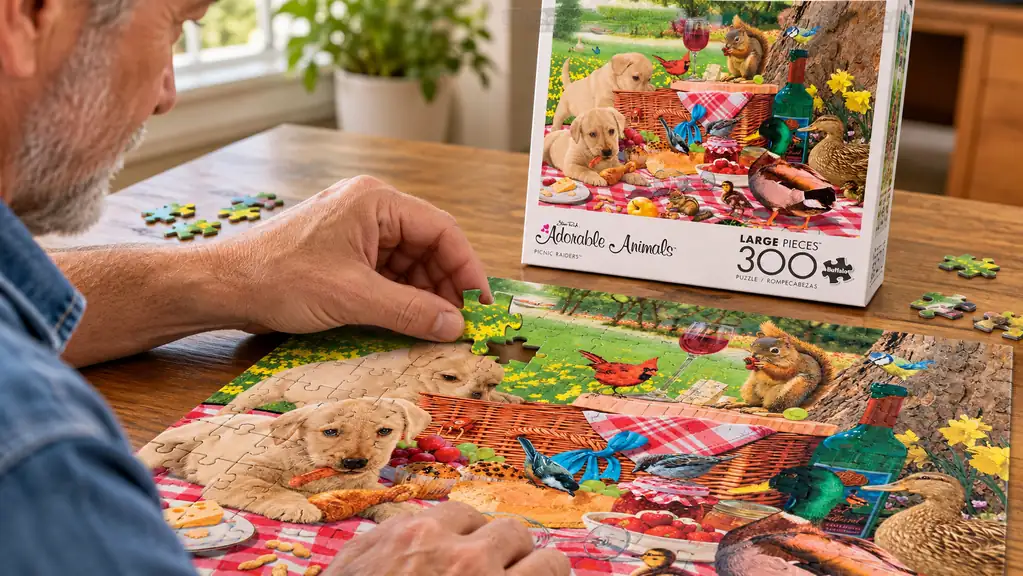
It is the Buffalo Games 300 large piece jigsaw puzzle called Picnic Raiders. Somewhere around month four it was still out, still in progress, still being picked at before breakfast. That is the review, really. Everything below is just the detail behind it.
The Quick Verdict
The right puzzle for hands that tire quickly. Big pieces, a small poster to work from, and a picture that holds up to months of staring. Not right if you want a challenge or a big frame-worthy finish.
Amazon Check Today's Price →The puzzle that stayed on my mother's table for four months
300 large pieces, a big reference poster in the box, and art with enough detail to hold a beginner for a long winter.
Amazon Check Today's Price on Amazon →How I've Used It
I did not buy this as a review product. I bought it because my mother called me in early January and said she had finished the book she was reading and did not have anything else to do, which is the closest June ever comes to complaining.
I brought it over and we started it together on a Sunday afternoon. I sorted the edges onto the table. She did the puppies in the middle, which is the sensible place to start with this one because the puppies are the part with recognizable shapes. By the time I left she had a corner working and told me she would rather I did not hover.
Before this one, I tried a shortcut. At Christmas I had given her a 1000-piece puzzle I found at a church sale, a nice one, thinking a puzzle is a puzzle. She worked at it for two evenings and then put it away. When I asked, she said the pieces were too small to pick up off the table, and she was tired of chasing them across the surface with the flat of her hand. That box went into her closet and I do not think it has come out since. The Buffalo Games puzzle was the correction, and it was a correction I should have made a year earlier.
Then I did what anyone honest does and I checked in. I called Tuesdays and Sundays as usual, and the report came back, with varying levels of detail. It was slow going in week one. Faster in week three once the border closed. Then it sat for about six weeks while her granddaughter visited and other things took over, and then it came back out and finished in April, and then it went back in the box and came out again in May with the pieces set up differently because she had forgotten which piece went where.
I have handled the pieces, sorted them, picked them up off a carpet, and put them back in the box. I have watched someone with stiff thumbs do all of it. That is the basis for what follows.
What the Pieces Are Actually Like
The box says 300 pieces, and the pieces are large. That is the point of the whole thing. Buffalo Games cuts them from thicker stock than a drugstore puzzle, so they do not bow when you pick them up by one corner, and the knob on each piece is big enough to pinch between two fingers rather than a fingertip and a thumbnail.
For my mother that difference is the entire purchase. She can pick up one of these pieces. She cannot pick up a standard 1000-piece piece off a flat surface without sliding it to the edge first and pressing it against the table. There is a specific dignity in being able to just pick something up, and unless you have watched someone you love lose that, it is hard to explain why a jigsaw matters.
Here is a specific thing that happened, because it makes the point better than a description can. On a Tuesday in February she dropped a piece onto the carpet, and she reached down and picked it up between her thumb and forefinger without getting out of the chair. In December, with the small-piece puzzle, a dropped piece meant I got a flashlight and a butter knife and we both ended up on the floor. That is the value in one small scene, and it is why I stopped shopping by piece count and started shopping by piece size.
The manufacturer lists the pieces as sturdy and easy to see, and that held up. Nothing delaminated in four months of handling. There was one slightly frayed corner on a piece June pried apart at an awkward angle, and one piece with a small bend in it that still worked fine. No missing pieces out of 300, which matters more than people realize when a puzzle has been dumped and resorted three times.
The material is paper board, and it is on the lighter side at eight ounces for the whole box, so this is not a heavy heirloom object. It is a well-made paper puzzle. It will do years of service if you treat it reasonably.
The Poster Is the Reason This Works
Every puzzle box shows a picture, but the picture is printed on the lid, and the lid does not lie flat next to the table, and the lid is small, and the lid is the reason my mother used to hold a box up at arm's length and squint.
This one includes a separate large reference diagram in the box. That one item changed how June worked. We propped it against the back of a chair and she could look up at it whenever she got stuck instead of lifting the box and losing her place entirely. It also let her work on the puzzle without me, which is the point of a gift like this.
We creased it in week two by folding it the wrong way, and I taped the back of the fold with clear tape on a Sunday in February. It stayed flat against the chair for the rest of the run. I also learned to fold it along the original folds instead of stuffing it back into the box, because stuffing it back into the box is what creased it in the first place. Small thing. It is the sort of small thing that decides whether a reference diagram gets used or ends up at the bottom of the box underneath the pieces.
The listing calls it a large reference diagram to support all skill levels, and that is accurate. It is not a laminated poster and it will crease if you fold it carelessly, which we did. A crease does not stop it working. Just do not expect a keepsake.
The Picture, and Whether It Holds Up
Picnic Raiders is a summer picnic scene with puppies, squirrels, birds and a lot of bright detail. I was worried it would be too busy, because busy art is exactly what makes a large-piece puzzle harder than it needs to be. Large pieces plus dense detail equals a beginner staring at a blanket pattern for twenty minutes.
It mostly avoids that. The puppies are big enough to be distinct, and the squirrels and birds give you recognizable anchors. There is enough color separation between the picnic blanket and the grass and the sky that you can sort pieces into piles that actually make sense, which is the small unglamorous skill that makes a puzzle pleasant rather than a chore.
The one honest complaint is the green. There is a lot of grass and a lot of foliage, and green-on-green is where June got stuck and stayed stuck, sometimes for days. She solved it by sorting every green piece into a bowl and going at it in batches. If a puzzle could be improved, this one would have more distinct boundaries in the background.
The finished picture is bright and cheerful and, per the listing, display-worthy. I would not frame it. Large-piece puzzles look like large-piece puzzles when finished, and framed it reads more like a poster than a keepsake. June put it back in the box without a second thought, and I think that was right.
There is a specific dignity in being able to just pick something up. Unless you have watched someone you love lose that, it is hard to explain why a jigsaw matters.
The Part Nobody Mentions: The Table Space
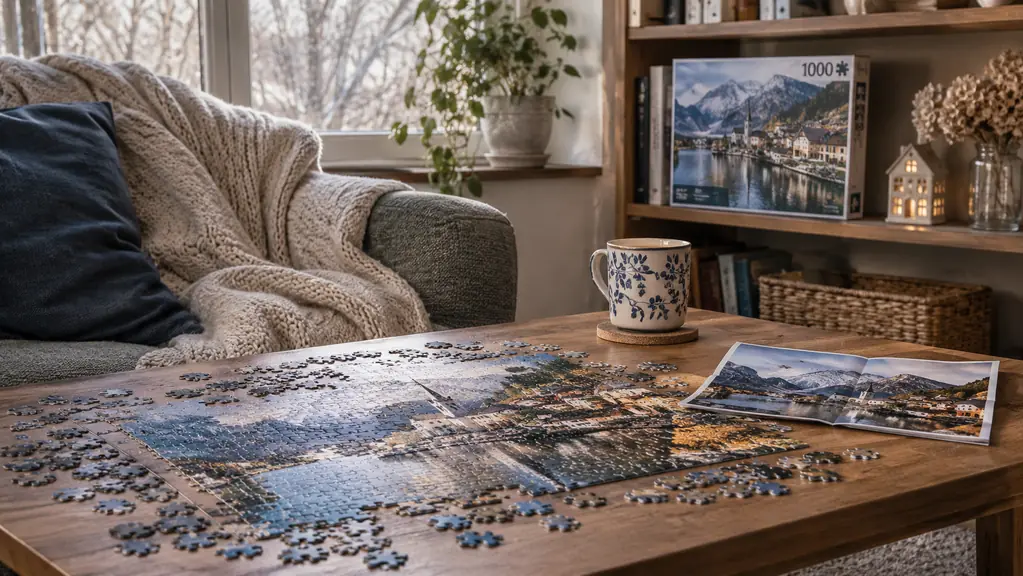
A large-piece puzzle takes up real estate. I did not think this through. June's apartment has one table that is not a dining table, and once the puzzle was out, the table was the puzzle. Her mail went on the arm of the chair. Her tea went on a side table. She did not seem to mind, but if your parent's space is tight, measure before you buy, because the finished puzzle needs the full footprint plus room to sort pieces.
We ended up buying a cheap folding tray to hold the sorted piles and it helped a lot. That is not a knock on the puzzle. It is a note for the person buying it. A puzzle is a piece of furniture for a few months.
The listing also notes a 90 day warranty against manufacturer defects, and the recommended age on the box is 14 and up, which is the standard safety label and not a difficulty rating. It is not a child's puzzle. It is a beginner's puzzle that happens to be suitable for adults who want something gentle. Worth knowing if you have grandchildren visiting who will want to help, because four-year-olds will absolutely grab for these pieces and the pieces will survive it.
How It Held Up Over Months
If you want the timeline, here it is. January, the border and the puppies. February, the picnic blanket, slow, with about two weeks where nothing moved at all because a cold kept her in bed. March, the grass, which took eleven days and one bowl of sorted green pieces. April, the last forty pieces, which she finished in a single afternoon and then sat looking at for a while. May, the resort, when she decided to take the whole thing apart and start over, and the Buffalo Games board came through that too without the print rubbing or the fit loosening.
The box corners went soft first, because the box lived on the floor next to the table and got kicked. The reference poster creased in week two. One piece got a slightly frayed corner. Those are the only wear items after four months of intermittent use, including a full resorting in May.
That is a good result for a paper puzzle. The pieces themselves did not lose their shape, the print did not rub off, and the fit stayed snug enough that finished sections could be slid across the table without falling apart, which is the test that separates a decent puzzle from a frustrating one.
What I Liked
- Large pieces that a person with stiff or arthritic hands can pick up without sliding them to the table edge
- Includes a separate large reference diagram, so the box lid stays out of the way
- Bright, well-separated art with clear anchors, so sorting into piles actually works
- 300 pieces is a real project without being a wall. Finishes in weeks, not months, if someone works at it
- Survived four months of handling, a full resort, and one prying-apart incident with no missing pieces
- Made in the United States from premium board and recycled materials
Where It Falls Short
- The green foliage and grass are hard to tell apart, and that is where beginners stall
- The reference diagram is paper and will crease
- A large-piece puzzle eats a whole table for as long as it is out
- The finished picture is cheerful but not frame-worthy
- Not a challenge for an experienced puzzler, and 300 pieces will feel thin to anyone used to 1000
Who This Is For
This is for the person who used to do puzzles and stopped, not because they lost interest but because the pieces got too small. If your parent has arthritis, tremor, or just eyes that are not what they were, 300 large pieces is the right shape of project. Big enough to feel like something. Small enough to finish.
It is also for the person who needs something to do that is not a screen. June's apartment has a television and she does not watch it. She wants her hands busy and her mind half-occupied, and a puzzle does that in a way a book does not when you are tired.
And it is a good gift from grandchildren, honestly, because it is cheap enough to give without ceremony and it produces a story. My granddaughter sat with her great-grandmother for forty minutes on a visit and did the whole border. That is forty minutes that would have been spent on a phone.
If you are buying for a parent rather than a grandchild, and this one works, I would buy another Buffalo Games 300 large piece next time rather than trying to find something better. When you hit on the thing that actually gets used, the sensible move is to repeat it.
Who Should Skip It
Skip it if the person is an experienced puzzler. 300 large pieces will be done in two sittings by anyone who does 1000-piece puzzles regularly, and the large pieces remove the part they enjoy. Buy them a normal 1000-piece instead and do not overthink it.
Skip it if there is no table. I mean this literally. If the only flat surface is the kitchen table that gets used for meals, this puzzle will be a nuisance and will end up back in the box unfinished, and unfinished puzzles feel like failure to the person who abandoned them. Check the furniture first.
And skip it if the person has significant vision loss rather than hand trouble. Large pieces help with picking up, not with seeing contrast. If the issue is eyesight, buy a puzzle with stronger color blocks and fewer same-color fields, and this one has more green than that would allow.
One more: if you are buying for someone who likes to be busy and productive rather than sit, a puzzle is the wrong gift no matter how good it is. Ron is like that. He would rather be in the garden. June is not.
Four months on the table, and my mother is still asking when the next one comes
300 large pieces with a big reference poster in the box. The version of a jigsaw that works for hands that have gotten stiff.
Amazon Check Today's Price on Amazon →