

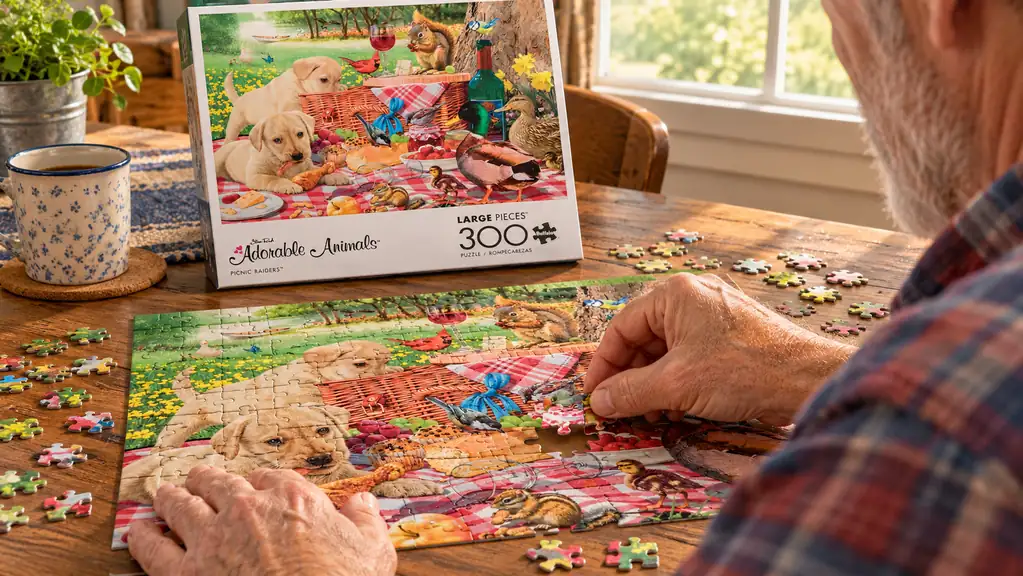
Short answer first, because that is what you came for: for most grandparents, the Buffalo Games Picnic Raiders 300 large piece puzzle is the better buy. Not because Ceaco makes a bad puzzle. Because two things decide whether a jigsaw gets finished at somebody's table, and Buffalo Games handles both of them. The pieces are large and sturdy enough that a hand with some arthritis in it can pick them up, and there is a real reference diagram folded in the box instead of just a picture printed on the lid.
I should tell you who is doing the comparing. I am Marla Ostrander, 63, a retired school librarian in Lancaster, Pennsylvania. I buy puzzles for my mother, June, who is 88 and lives in an assisted living apartment twenty minutes from my house. Her hands bother her. She is sharp as a tack and will not be handed a children's puzzle, which is the trap a lot of large-piece puzzles fall into. So I have spent a few years buying them, opening them, and watching which ones get finished and which ones end up stacked on the radiator with forty pieces done.
| Buffalo Games Picnic Raiders | Ceaco large piece | |
|---|---|---|
| Large piece sizing | 300 large, sturdy pieces sized to be easier to see, pick up, and place | Sizing varies by title, so you have to read the box before you buy |
| Reference help in the box | Comes with a large reference diagram, plus a poster | Lid photo only, in the boxes I have opened |
| Board and piece fit | Premium board, made in the United States with recycled materials, and a firm fit | Feels a little thinner in my hands and the fit is looser |
| Artwork | Lively picnic scene with puppies, squirrels, birds, and bright summer detail | Tends toward landscapes and Americana |
| How often the catalog changes | A set catalog that does not chase every theme | More titles rotating through the large-piece line |
| Finished look on the table | Display-worthy when it is done, with detail in every quadrant | Perfectly presentable, but less detail to look at |
| Best for | A grandparent who wants to finish in a few sittings with a diagram to follow | A puzzler who wants a new image every few weeks |
Read that table the way I read it. Buffalo Games wins on the things that determine whether the box gets opened a second time. Ceaco wins on variety, which matters if the person you are buying for finishes a puzzle a month and wants something new to look at. Neither of those is a small thing. They are just different things.
How I Compared Them
I did not do lab testing. I did something more useful. I got both puzzles onto June's table on separate visits, and then I left the room. What I care about is what happened over the next week, reported back to me by phone, usually with some commentary about the dining room staff.
There are only three questions in my notebook. Can she pick the pieces up without chasing them across the table. Can she tell where a piece goes without leaning in and holding it at arm's length. And can she set it up herself, or does she have to wait for me or an aide to get her started. Everything else, the artwork, the box, the brand name, is decoration on top of those three.
Why Piece Size Is the Whole Argument
Large piece is not one standard size. It is a marketing phrase, and every brand means something a little different by it. A 300 piece puzzle with genuinely large pieces gives you a picture that builds fast, which is the point. June can finish a section in an afternoon, see real progress, and leave it out on the table without it becoming a two-week occupation of the dining room. That matters more than it sounds. A puzzle that takes three weeks stops being an activity and starts being furniture.
The Buffalo Games box says large, sturdy pieces, easier to see, pick up, and place, and my hands agree with the box. What I noticed most is the thickness. A thin piece bends when an older hand presses down on it wrong, and a bent piece never quite sits flat again. June has a small pile of those from other puzzles. She does not have one from this one, and she has done it twice.
I got curious enough to measure one, against a piece from a standard 1000 piece box I had in the closet. Roughly double the width on each side, which does not sound like much until you are the one picking it up off a tablecloth. Before I found this box I tried a standard puzzle with June, thinking the picture would carry it. Forty minutes in she had eight pieces placed and a sore wrist, and we put it away. That was the last time I bought a small-piece puzzle for her.
The reference diagram is the part nobody mentions in the listing photos, and it is the part that decides whether the box gets opened a second time.
Where Buffalo Games Wins
It wins on the diagram, so let me start there. The box includes a large reference diagram, separate from the lid, plus a poster. That sounds like a small courtesy. It is not. A lid photo is printed on curved cardboard and it is genuinely hard to use if your eyes are 88 years old. A flat sheet you can put right beside the puzzle is a different tool entirely. June props hers against the sugar bowl and works left to right. She has never once asked me to find a piece for her, and with other puzzles she has.
It wins on the picture, too. Picnic Raiders is a busy scene, puppies and squirrels and birds and a lot of summer detail, and busy is good here. Large pieces plus a sparse image is a frustrating combination, because every piece is a big blank patch of sky. This one gives you plenty of distinct objects in every quadrant, so there is always somewhere to start. It is also good-looking enough that June left it finished on the table for four days before she took it apart, which is the highest compliment she gives.
Where Ceaco Wins
Ceaco wins on selection, plainly. If you walk into a store wanting a large-piece puzzle, the Ceaco shelf turns over more often and carries more subjects, so you have a better chance of matching the picture to the person. If your grandmother loves lighthouses and nothing else will do, Ceaco is more likely to have a lighthouse that week. Buffalo Games has a set catalog and does not chase every theme.
Ceaco also wins on the thing nobody wants to say out loud, which is disposability. In a shared dining room or a senior apartment, pieces go missing. They get swept up, they get borrowed, they get carried off by a visiting dog. A puzzle you are not emotionally invested in is a practical choice in that setting. If the box gets rained on or half the pieces vanish, you have lost a puzzle and not a keepsake, and there is a certain freedom in that.
The puzzle June finished twice and never once asked me for help with
300 large, sturdy pieces, a real reference diagram folded in the box, and artwork busy enough that there is always an obvious place to start. If you are buying for hands that have some miles on them, start here.
Amazon Check Today's Price on Amazon →What 300 Pieces Actually Means on a Tuesday Afternoon
It means about three sittings for a person who is motivated and working alone. June did the border on a Tuesday, most of the middle on Wednesday, and finished it Thursday morning before lunch. That rhythm suits an assisted living schedule, where you might have an hour after breakfast and another hour before dinner and no more than that.
Wednesday was the slow day, as it usually is, because the border is done and the middle is a wall of loose pieces. She told me she worked in stretches of about twenty minutes and then got up for a glass of water and a look out the window. Thursday she called me before nine to report it was finished, which is earlier than I expected and faster than the last one she did.
It also means it fits on a small table. June's apartment has one round table that seats two, and 300 large pieces take up most of it but not all of it. A 1000 piece puzzle would have meant setting up a card table in the bedroom, which she is not going to do. The count is not a compromise here. It is the reason the puzzle gets used at all.
Setting It Up Without Calling Anyone
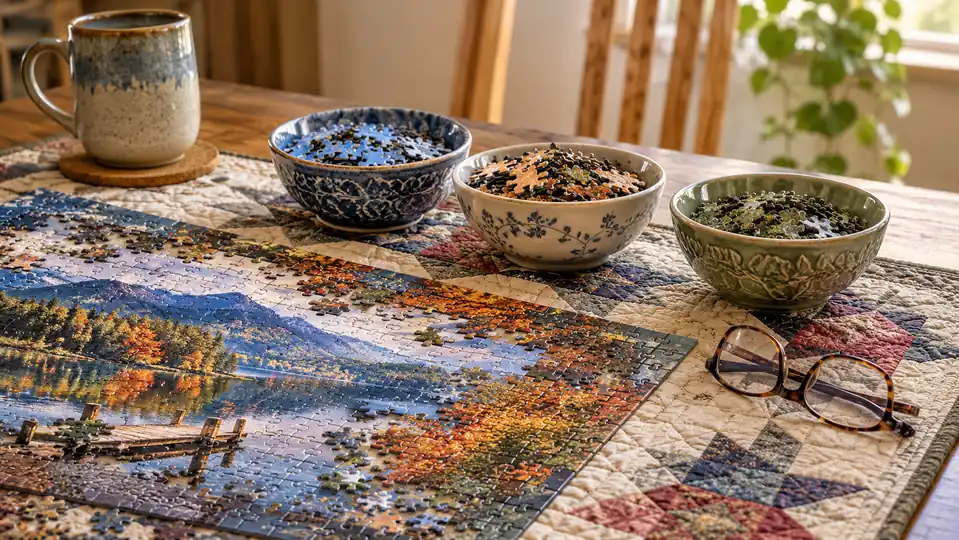
One of my three tests is whether June can set the thing up herself, and this is where a lot of gifts quietly fail. Not because they are complicated, but because they arrive in a way that requires a second person. The Buffalo Games box is straightforward. You open the lid, tip the bag out, and the diagram is right there. June had it spread out before I got my coat off.
I timed it once, which is an odd thing to do to your own mother, but I wanted a number for this piece. From lifting the lid to having the diagram propped against the sugar bowl and the pieces spread across the table was under four minutes, and most of that was her deciding which chair to sit in. Nothing in that sequence needed me.
That sounds trivial and it is not. A gift that needs you present is a gift that gets used when you are present, which for most of us is once a month. A gift that sets itself up gets used on a Wednesday when nobody is there. Ceaco is not difficult either, to be fair. It is the diagram that makes the difference, and I will keep saying it because it is the most overlooked thing in this whole category.
The Age Rating Says 14, and That Confuses People
The box says 14 years and up. I want to head that off, because it stops people in the aisle. That number is a manufacturer's safety and small parts convention, not a statement about who the puzzle is for. A 300 piece puzzle with large pieces is genuinely easy to assemble. My ten-year-old grandchild could do it, and my mother who is 88 does it happily.
What the rating actually tells you is that the pieces are small enough to be a hazard around a toddler, which is true of nearly every puzzle. If you are buying for a child under three, no. If you are buying for an adult whose hands are stiff, yes, and ignore the number in the corner of the box. I have watched more than one friend put a perfectly good large-piece puzzle back on the shelf because of that figure.
Things Neither Puzzle Fixes
Neither one comes with somebody to sort the edge pieces for you. Neither one solves the problem of a table that is also where meals happen, so if the person you are buying for eats at the same table, a piece of felt or a roll-up mat is the accessory that actually gets used. And neither one is a good gift for someone with significant hand weakness or a tremor. Large pieces help with that, but they do not solve it. For that you want a puzzle with a frame or sorting trays, and honestly, you want to be there to help.
The other thing neither one fixes is the light. June's apartment has one lamp over the table and it sits behind her shoulder, which throws a shadow exactly where she is working. I clipped a small reading light to the table edge in March and it changed her afternoons more than any puzzle I have bought her. If you are putting together a gift, that light is worth more than a second box.
What I Liked
- Large, sturdy pieces that are easier to see, pick up, and place
- A separate large reference diagram plus a poster, not just a lid photo
- Busy, detailed artwork, so there is always an obvious place to start
- 300 pieces is a three-sitting project, not a three-week occupation
- Premium board, manufactured in the United States with recycled materials
Where It Falls Short
- The catalog is smaller than Ceaco's, so theme choice is limited
- 300 pieces is too quick for an experienced puzzler
- Not a substitute for help if hand strength is seriously limited
Who Should Buy Which
Buy the Buffalo Games puzzle if the person you are shopping for wants to finish something. If they are in their eighties, if their hands are not reliable, if they will be working alone at a small table, and if you want the gift to be used rather than admired, this is the one. It is also the better choice if you plan to sit and work on it with them, because the diagram lets two people work from the same picture instead of one person holding the lid.
Buy the Ceaco if the person is an experienced puzzler who wants a new image every few weeks, if they have a specific theme in mind, or if the puzzle lives in a communal space where pieces disappear. There is nothing wrong with that choice. It is just a different afternoon, and I would rather you pick the right afternoon than the right brand.
If you remember one thing from all of this, remember the diagram
Piece size and a flat reference sheet are what decide whether a puzzle gets finished. The Buffalo Games Picnic Raiders box has both, at 300 large pieces, for hands that have some miles on them.
Amazon Check Today's Price on Amazon →