

Here is the problem with journals you buy for someone else. Most of them get about eleven pages of use and then go to the bottom of a drawer. I have given plenty of them. I have also watched my mother, June, who is eighty-eight and lives twenty minutes from me in an assisted living apartment, open a fresh notebook, write the date, and close it again because she could not think of a single thing worth saying. So when I handed her the Tell Me Your Life Story, Grandma journal, I was not expecting much. I was expecting the drawer.
Three months later it lives on her coffee table instead. That is the short version of this review, and it is the part that surprised me most. The book did not need her to be a writer. It needed her to answer a question, one at a time, which is a completely different job. What follows is what an honest review looks like in my house. The good, the parts that annoyed both of us, and a straight answer to whether the person you are shopping for will actually use it.
The Quick Verdict
A guided journal that asks a specific question and then gets out of the way. Best for a grandmother who likes to talk about the old days and a family willing to read what she writes. Not built for someone who dislikes writing by hand.
Amazon Check Today's Price →The journal my mother finished instead of abandoning
One question at a time, 122 pages, and a book that ended up on the coffee table instead of in a drawer. Check today's price and look at the sample pages before you decide.
Amazon Check Today's Price on Amazon →What This Book Actually Is, Without the Marketing
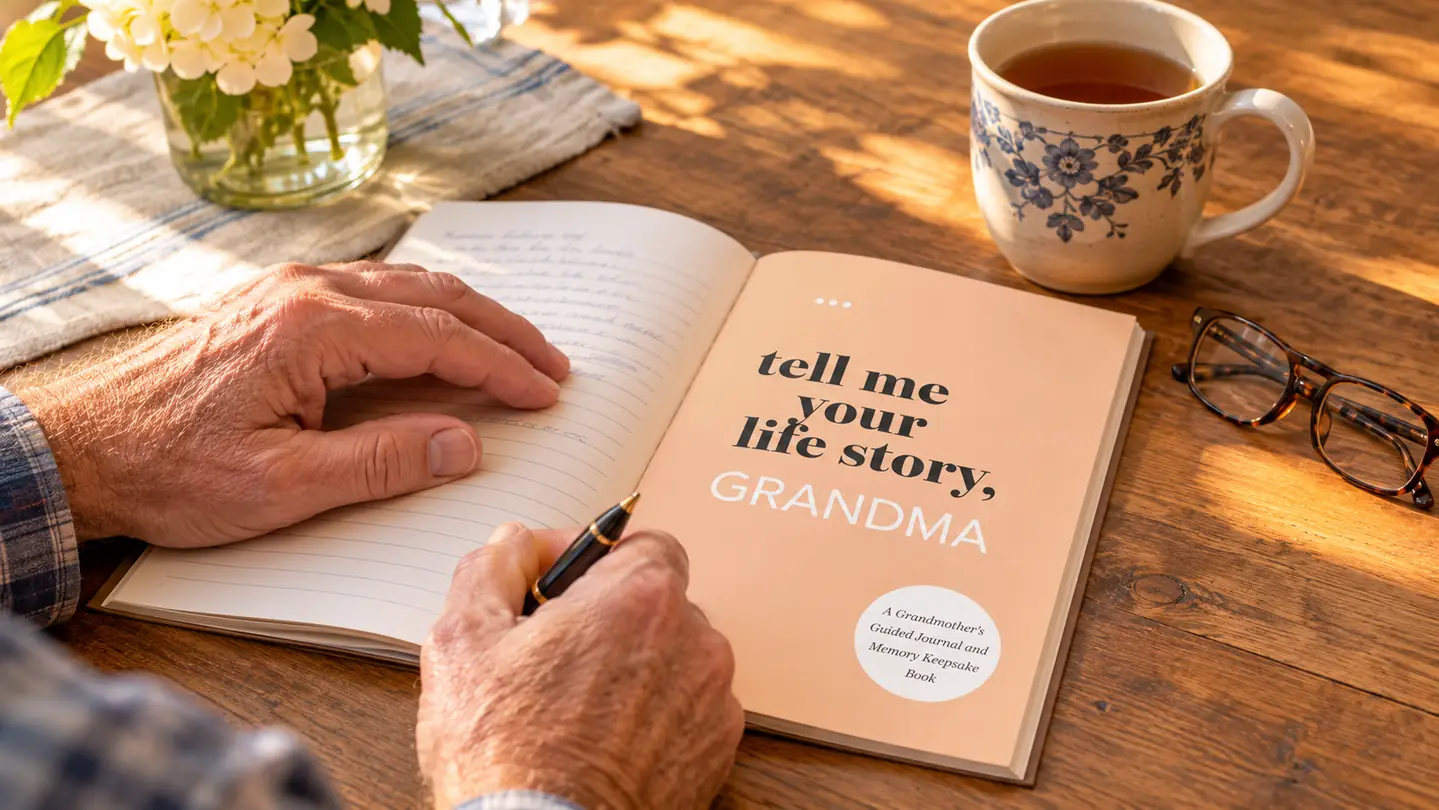
Let me describe it plainly, because the product photo does not do the job. Tell Me Your Life Story, Grandma is a guided journal, which means the pages are built around questions instead of waiting for you to invent a subject. It runs 122 pages and measures seven by ten inches, so it reads more like a thin workbook than a heavy coffee table book. At a little over nine ounces, my mother can hold it in one hand without her wrists complaining, and she cannot say that about the photo albums stacked in her closet.
The inside is plainer than the cover suggests. Each spread puts the question at the top, a line or two under it if the question needs setting up, and then a block of blank space for the answer. Nothing on the page asks her to be funny or profound. There is no scoring, no prompts to circle, no boxes to tick. The listing puts it at 0.28 inches thick, and that thin binding has held through three months of being carried from the coffee table to the kitchen counter and back, which is more travel than most of the books in her apartment get in a year.
It was published in April 2021 by Questions About Me, and it belongs to the Tell Me Your Life Story Series Books, which is worth knowing if you are shopping for more than one person this year. The text is in English. That sounds like a silly thing to verify until you have watched a keepsake arrive printed in a language its recipient does not read.
What it is not matters just as much. It is not a scrapbook. There are no pockets for photographs, no envelopes for ticket stubs, no place to paste the program from a wedding. If the gift you have in mind involves glue, this is the wrong purchase, and I would rather say so here than have you find out on a birthday. It is also not a biography. Nobody is going to organize your grandmother's answers into chapters. The book asks, she answers, and the shape of the story is whatever she makes of it. That is either the appeal or the problem, depending entirely on who is holding the pen.
How We Tested It, and Where She Stalled
My mother is not a sentimental woman by nature. She is practical. She raised four children, she keeps her opinions, and if you ask her whether her life has been interesting she will say no and change the subject. The reason this journal worked on her is that it never asks that question. It asks something small and answerable, and by the time she has finished answering she has remembered three other things she had not thought about in years.
The first week she wrote two pages and then stopped. I want to be honest about that, because a review that pretends the first week went smoothly is not worth reading. Before the tea trick, I tried the obvious thing first. I left the journal on her kitchen counter with a pen clipped to the cover and a note that said no rush on it. That lasted four days. She moved it to the sideboard to make room for a bowl of apples, and the sideboard is where books go to be forgotten in her apartment. What restarted her was me sitting at her table with a cup of tea, reading the question out loud and then waiting. She answered it talking. Then she wrote down what she had just said, almost word for word. After that she did not need me in the room, though I kept turning up anyway, mostly for the tea.
By the end of three months she had worked through a good portion of the book. Not all of it. She skipped a stretch in the middle and went back later, which the book allows because nothing is numbered like homework. The behavior I cared about was this. The journal stayed open on the arm of her couch so she could return to a question when something occurred to her. That is what a usable gift looks like. Not the excitement on the day it is unwrapped, but whether it is still out three months later when nobody is watching.
The book did not need her to be a writer. It needed her to answer one question at a time, which is a completely different job.
The Part Nobody Mentions About Guided Journals
Here is the part I did not understand before we started. A guided journal is not really a gift for the person writing in it. It is a gift to whoever ends up reading it. My mother writes in hers partly because she likes the routine and partly because she has decided one of the grandkids will want it someday. That changed how she treated the pages. She stopped worrying about her handwriting and started worrying about being understood.
That has a practical consequence for you as the buyer. If nobody in your family is going to read it, the book loses half its pull. It still works as a private ritual, and there is nothing wrong with that, but the strongest version of this gift is a handoff. Buy it, give it, then say out loud that you want to read it one day. My mother wrote with more detail after I said that. Fewer generalities, more names and dates and the occasional opinion about a neighbor.
It also means the book fits a certain kind of grandmother better than others. The ones who like to talk about the old neighborhood. The ones who keep photographs in a shoebox and can name everybody in them. The ones who say nobody wants to hear about that and then talk for twenty minutes anyway. If that is your grandmother, Tell Me Your Life Story, Grandma is a good match. If she is private to the bone and dislikes being asked personal questions, no journal on earth will change that, and you should take her at her word.
Where It Falls Short
The paper is not heavy. My mother writes with a broad pen and it showed through on a couple of pages early on, so we switched her to a finer one and the problem mostly went away. Here is the specific of it, because specifics are what make a review useful. The show-through showed up on page nine, a question about her first job, written with a felt tip she keeps in a cup by the telephone. Holding the page to the window I could read the words bakery on King Street through the paper from the other side. Nothing was ruined. It just looked messy, and she is a woman who cares about messy. I swapped her to a fine ballpoint from the drawer in my own kitchen and the next forty pages came out clean. If the person you are buying for has a favorite pen and it is a fat one, buy a thin one too and hand them both over at the same time.
Second, there is no structure imposed on the answers. Some pages my mother filled corner to corner. Some got two sentences and a shrug. The book does not mind, which is the point, but a person who likes a syllabus may feel adrift without one. There was no suggested order and no checklist for her to work against. A more organized grandmother would probably invent her own system within a week. Mine did not, and it did not matter in the end, though I would have felt better with a checklist.
Third, and this is the real one, it is a one-way conversation. The journal asks, she answers, and there is nobody on the other end of the page. If you want a back and forth, you have to add it yourself. My solution was a stack of sticky notes. She writes a page, I read it, I stick a question back on the next blank page. By the middle of the summer there were nineteen of them fanning out of the back cover. That is not the book's job. The book is still better with it, and the sticky notes are now the part she looks forward to.

How It Compares to a Blank Notebook
The obvious alternative is the notebook everyone already owns. A plain blank book has no rules, no questions, and no ceiling. It is also the thing that sat on my mother's shelf for two years with three pages filled in and a grocery list on page four. That is the trade you are making. You give up some freedom to get a question that is already sitting there waiting for an answer.
I have proof of this in my own family. My mother has two blank notebooks in her apartment right now. One came from a drugstore in 2022, a nice cloth cover, and it holds four pages of a shopping list and a phone number with no name attached to it. The other was a gift from a neighbor, and it has never been opened, which I know because the spine still cracks when you bend it back. Neither of those is a failure of my mother. They are a failure of the format for her. A page with nothing on it asks her to decide what matters, and at eighty-eight she would rather decide what to have for lunch.
For a certain kind of person, a blank notebook really is better. If your grandmother already writes, already keeps a diary, already has a system, do not hand her homework. The guided format would feel like being assigned an essay. But if she is the person who opens a fresh book, looks at the empty line, and closes it again, the blank page is the enemy and the question is the gift. That was my mother. Two years of blank notebooks versus ninety days of a journal that asks. There is a longer side-by-side of those two options on this site if you want the detail without the story.
What I'd Put in the Box With It
A decent fine-tipped pen, because the broad one showed through the page. A pack of sticky notes, so you can write follow-up questions in the margins and turn a one-way book into a conversation. And one thing that is not a thing at all, a promise that you will read it. That last part costs nothing and it is the reason my mother kept going past the first week.
If you are wrapping it for a holiday, tape a note to the inside cover in your own handwriting, something like start anywhere, there is no wrong order. She will read that note more than once, and it takes the pressure off the first page. Small additions, but they moved the journal from a nice object to something she used, and I would not give it now without them. There is also a longer-term look at this same journal elsewhere on the site if you want to know how it holds up past the first season.
What I Liked
- The questions do the hard part, so she never has to invent a subject
- Seven by ten inches and a little over nine ounces, light enough for arthritic hands to hold
- 122 pages is enough to be a real project without turning into a chore
- Part of a series, so you can buy for more than one person in the same year
- Sturdy enough to survive three months living on the arm of a couch
Where It Falls Short
- A broad pen showed through on a couple of pages, so we switched pens
- No checklist or suggested order for a grandmother who likes structure
- No pockets for photographs, which some families will expect from a keepsake
- It only pays off if someone in the family actually reads it later
- A poor fit for a grandmother who dislikes personal questions
Who This Is For
Buy this for a grandmother who talks. Not the polished storyteller, the one who rambles. The one who starts a sentence about a bakery in 1955 and ends up somewhere else entirely, then finds her way back. Buy it for a family that will actually read the answers, because half the value lives on the reading end. Buy it if you are willing to spend twenty minutes on the first page with her, reading the question out loud and waiting, because those twenty minutes are what turn a book into a habit. Tell Me Your Life Story, Grandma is, in my house, the rare grandparent gift that got used and then got talked about at dinner.
Who Should Skip It
Skip it if she has told you, plainly, that she does not like writing by hand. Believe her. A guided journal handed to someone with hand pain or a distaste for the physical act of writing becomes a small guilt machine, and she will feel obliged to use it and then feel bad when she does not. Skip it if what you actually want is a scrapbook, because this is not one. And skip it if you are buying it to avoid a conversation. The book does not replace sitting down with her. It gives you something to sit down with, which is a different and smaller thing, and it still works.
If she talks, she will fill it
122 pages, seven by ten inches, and a question already sitting on the page. My mother kept hers on the coffee table for three months, which is longer than any blank notebook ever lasted. Check today's price before you decide.
Amazon Check Today's Price on Amazon →