

My mother, June, is 88 and lives in an assisted living apartment twenty minutes from my house in Lancaster. She has mild arthritis in her hands and a photo of the family on every flat surface she can find. Last winter I brought her two things to try: a plain blank notebook and Tell Me Your Life Story, Grandma. I did not bring them as a test. I brought them because I wanted her stories written down before the details started to blur, and I was tired of saying we should do that someday.
After a few weeks, the difference was clear. The blank notebook sat closed with a pen on top of it. The guided journal sat open with a pen clipped to the page. That is the short answer: for most families, Tell Me Your Life Story, Grandma is the better choice because it removes the blank-page problem. A blank notebook is better only if the writer already knows what she wants to say and wants the freedom to say it her way. The book is 122 pages, 7 by 10 inches, and 9.1 ounces. Those numbers matter less than the habit it creates, but they tell you what you are handing over.
| Tell Me Your Life Story, Grandma | A blank notebook | |
|---|---|---|
| Getting started | Guided pages give the writer a question to answer | The first page is empty and waiting for a beginning |
| Structure | The book supplies a path through the memories | The writer supplies all the structure |
| Freedom | The book sets the direction | Any subject, any order, any length |
| Keepsake purpose | Built as a guided journal and memory keepsake book | A notebook becomes a keepsake only if someone treats it that way |
| Other uses | Made for life stories | Can hold recipes, lists, travel notes, or sketches |
| Size and weight | 7 by 10 inches and 9.1 ounces | Depends on the notebook you choose |
| Ease on a tired day | A short answer still finishes a page | A short entry can feel like a false start |
How I Compared Them
I did not run a focus group or pretend this was a clinical trial. I put both books on June's table in January and paid attention for six weeks. I wanted to know three things: which one she picked up without being asked, whether she could use it on a day when her hands hurt, and whether the pages felt like something the family would keep. That is a low-tech method, but it is the method most families actually have.
The blank notebook was a good one, with a sturdy cover and clean pages. That may have been the problem. It was too nice to spoil with a bad first sentence. June turned it over, read the cover, and set it down. The guided journal had a question at the top of the page, so there was no decision to make about where to begin. She answered one question that first night. Then another the next night. By the end of the week she had a small stack of stories I had never heard.
June is not a reluctant person. She ran a household, raised three kids, and has an opinion about most things. She is, however, 88 and practical. She does not like to waste paper or time. A blank notebook asks her to decide what is worth writing. A guided journal makes that decision for her, one page at a time. That is not a small difference. It is the whole difference between a gift that gets used and a gift that gets moved from the table to the shelf.
What the Guided Journal Actually Is
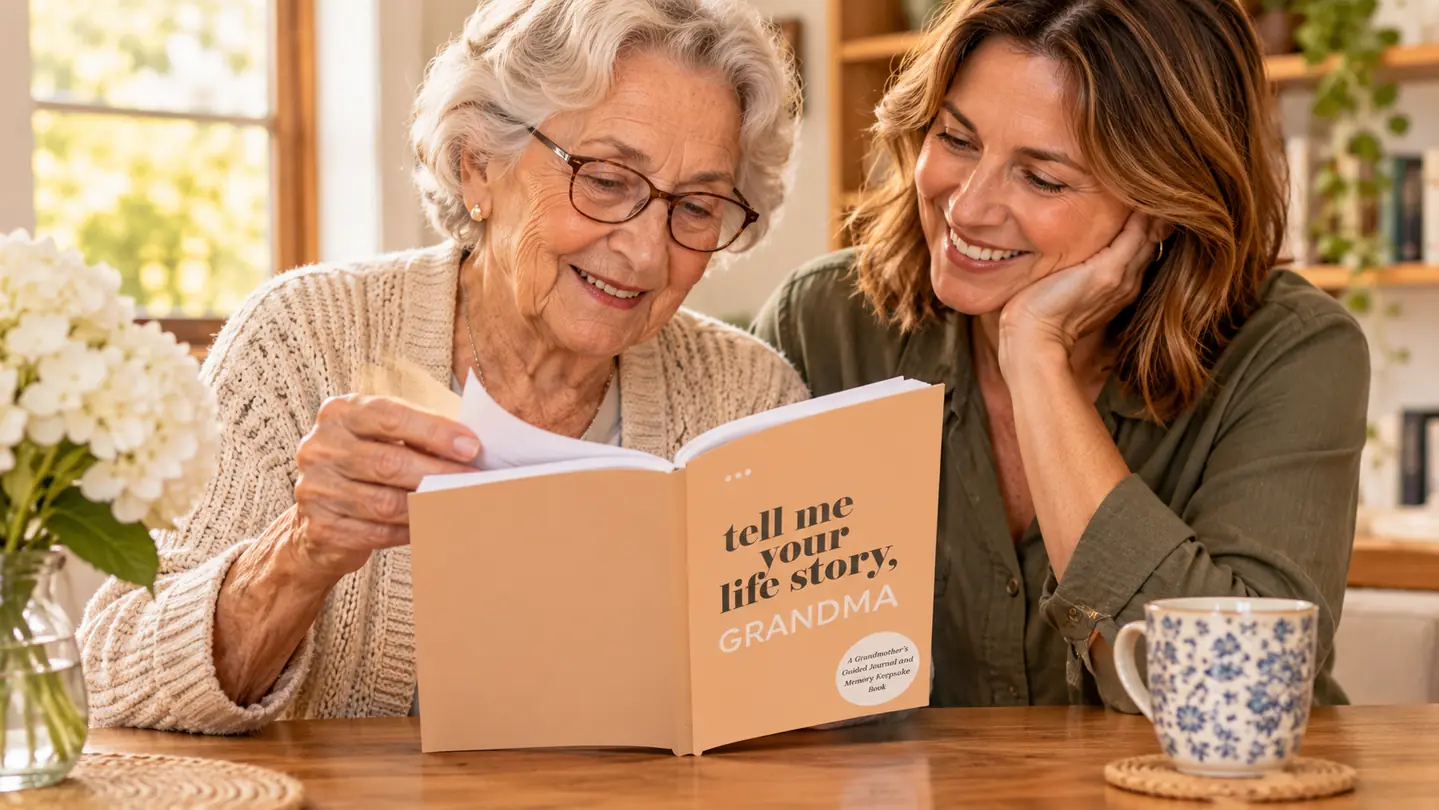
Tell Me Your Life Story, Grandma is published by Questions About Me, came out in April 2021, and runs 122 pages. It is part of the Tell Me Your Life Story Series Books. The title calls it a guided journal and a memory keepsake book. That is how it behaves in practice: the pages give the writer a place to start instead of asking her to invent a beginning from nothing.
I am not going to pretend a book can make someone a writer. June still has good days and bad days with her hands. On a bad day she answers one question in two sentences. On a good day she fills half a page. The guided format helps because she does not have to hold the whole story in her head at once. She reads the page, answers it, and stops when she is tired. A blank notebook gives her no place to stop and no place to start.
The physical book is light. At 9.1 ounces and 7 by 10 inches, it fits on the little table beside her recliner and does not slide off her lap. The 0.28 inch thickness means it is thin enough to leave out without turning the room into an office. That sounds like a small thing until you watch an 88-year-old try to manage a heavy album with sore hands.
The 4.8-star average across more than 4,400 reviews tells me other families have found the same thing. I do not treat reviews as proof of a personal fit. I treat them as evidence that the book arrives as described and holds up to normal use. The rest depends on the grandmother, her hands, and whether she wants to be asked.
One thing I noticed is that the guided journal gave June permission to write short. She did not have to produce a chapter. She could answer the page and close the book. That matters for an 88-year-old with arthritis, and it matters for a 63-year-old like me who has been meaning to write down her own stories too. The book sets a size for the task, and the size is small enough to finish.
A blank notebook asks her to remember how to begin. A guided journal asks her a question.
Where Tell Me Your Life Story, Grandma Wins
Tell Me Your Life Story, Grandma wins on the first five minutes. That is where most family history projects die. You hand someone a blank notebook and say, write your life story, and you have handed them a chore. You hand them Tell Me Your Life Story, Grandma and the page is already doing some of the work. The writer can answer a question instead of facing an empty page.
It also wins on consistency. A guided book keeps the project in one place and gives it a shape. June's answers are not in order. Some are long, some are short, and some repeat a detail she has told before. But they all belong to the same book. When my grandkids visit, they can open it and find a story without sorting through a drawer of loose paper. That is the keepsake part, and it is the reason I would buy it again.
It wins as a gift because it explains itself. You do not have to give a speech about why the person should fill it in. The cover says what it is. The pages make the request. For a family that has been meaning to collect stories for years, that is enough to get the project off the floor.
It also wins when the family is involved. My grandkids are four to fourteen, and they do not have the patience for a long interview. They will sit with June and ask her about one page. The guided book gives them a script without making it feel like a script. That is a strange kind of gift, but it is the kind that gets used.
It wins when you are the one who has to ask. I am 63, and I have my own stories that I have not written down. When I sat with June and the guided book, I did not have to interview her. I could read the page and say, tell me about this. That made the conversation easier for both of us. The book did the prompting, and I did the listening.
Where a Blank Notebook Wins
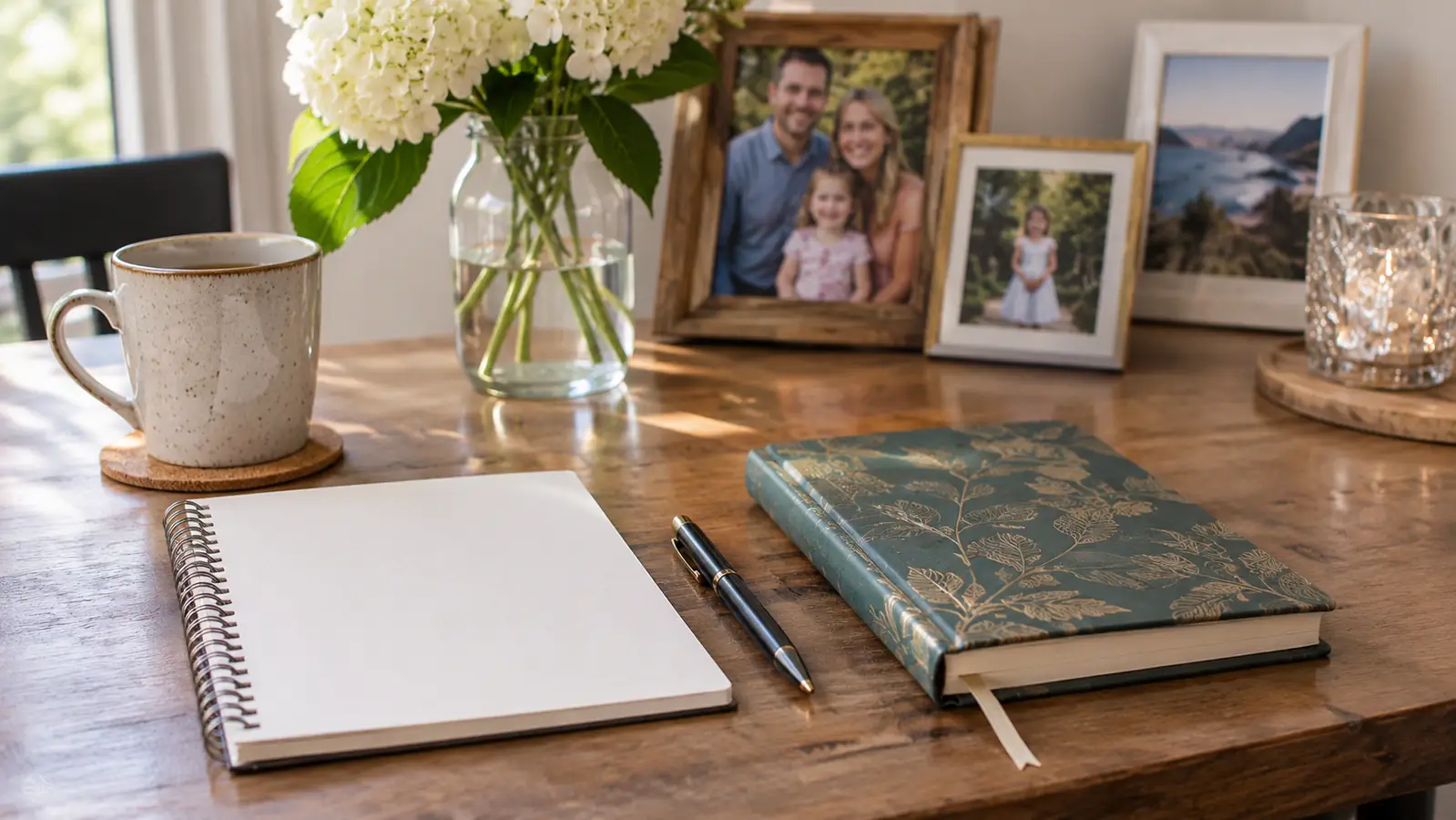
I have to be fair to the blank notebook. It wins on freedom. If your mother is a writer, a journal keeper, or a person who has already been recording family stories for years, a guided book can feel like a school worksheet. A blank notebook lets her choose the order, the length, and the subject. She can write about the war, her first job, or the neighbor's dog without a page suggesting otherwise.
It also wins on range. A blank notebook can become a recipe book, a travel log, a place to tape photos, or a grocery list. The guided journal has one job. If you are not sure the person wants to write about her life, a blank notebook is the lower-commitment choice. It does not announce a project. It just sits there and waits.
The blank notebook is also easier to replace and easier to carry if you pick a small one. That flexibility is real. But it comes with the same problem that made June set it down. The first page is still empty, and the person holding it still has to decide what her life story sounds like.
If the grandmother is private, a blank notebook may be kinder. Some people do not want to be asked direct questions about their childhood, their parents, or the hard parts. A blank notebook lets them offer what they choose. The guided book is not nosy, but it does ask. You know your grandmother. If she would rather choose the door, give her the blank pages.
The Hardest Part Is the First Page. This Book Removes It.
Tell Me Your Life Story, Grandma gives a grandmother a guided place to start, 122 pages to fill at her own pace, and a keepsake your family can open together. If the blank page is what has been stopping her, start here.
Amazon See the Guided Journal on Amazon →Who Should Buy Which
Buy Tell Me Your Life Story, Grandma if the grandmother in your life is like June: she likes the idea of leaving her stories behind, but she would never sit down and outline her life from scratch. Buy it if you want a gift that comes with a built-in reason to call her. Buy it if you have watched a blank notebook sit on a shelf for a year and you are ready to try something with a little more direction.
Buy a blank notebook if she already writes. My husband Ron is not a journal person, but he keeps a notebook for garden dates and seed orders, and he would find a guided life story book presumptuous. Some grandmothers are the same. If she has a strong sense of how she wants to tell her story, give her the blank pages and stay out of her way.
A middle path works too. Give the guided journal and a plain notebook together. The guided book gives her a starting point, and the notebook gives her room for the stories that do not fit a question. That is what I ended up doing with June. The guided book is the one she uses. The notebook is where she jots down names she wants to look up.
If you are buying for a grandmother with arthritis, the guided journal is still workable, but do not expect a finished memoir. Short answers count. The point is the record, not the length. June's two-sentence answers are often better than a long essay because they sound like her. The book is a tool for getting those sentences on paper, not a test she has to pass.
For a grandmother in assisted living, the guided journal has one more practical advantage. It is a thing to do that is not television. June keeps it on her side table, and when a friend stops by, they can look at a page together. The blank notebook did not start conversations. The guided book did. That is not in the specs, but it is what I saw.
Give Her a Place to Start, Not a Blank Page
If you have been meaning to ask for her stories, this is the nudge. The book is ready when she is, one page at a time.
Amazon See Tell Me Your Life Story, Grandma on Amazon →