

The first thing I noticed about the Buffalo Games Picnic Raiders 300 Large Piece Jigsaw Puzzle was not the picture. It was the size of the pieces in my mother's hands. June is 88 and lives in an assisted living apartment twenty minutes from me. She has mild arthritis in her hands, and she loves photos of the family. A standard 1,000-piece puzzle is not a gift for her anymore. She cannot pinch the small pieces without frustration, and frustration turns a pleasant afternoon into a chore. I put this puzzle on her table, and she turned one piece over twice, set it down, and said, 'I can see this one.' That is the whole reason I bought it. The rest of this review is about the tradeoffs.
I am Marla Ostrander, 63, a retired school librarian in Lancaster, Pennsylvania. I buy gifts for June, for my husband Ron, and for four grandkids who range from 4 to 14. I have learned that a gift for an older person has to pass three tests. Can she use it without calling me for help? Does it feel personal enough that she wants it on her table? Will it stay out of the closet after the first week? The Buffalo Games puzzle passed two of those tests clearly and stumbled on the third. The picture is sweet, the pieces are genuinely easier to handle, and the 300-piece count is short enough for a visit. The stumble is that short count: for a practiced puzzler, this is an evening, not a season.
The Quick Verdict
A well-made 300-piece puzzle with large pieces and a poster. It is a strong choice for older hands and casual visits, but it is too easy for adults who want a real challenge.
Amazon Check Today's Price →The large pieces are the point. See the 300-piece Picnic Raiders puzzle.
Buffalo Games lists 300 large pieces, a reference poster, and a beginner skill level. If that matches the person you are buying for, this is the version to look at.
Amazon Check Today's Price on Amazon →How I Tested It With My Mother
I did not run a stopwatch or turn this into a clinical trial. I set the puzzle out on June's table on a Saturday afternoon, put the poster beside it, and left the room. That is the real test. If she needs me to hover, the gift has failed. When I came back twenty minutes later, she had the border started and a small pile of pieces sorted by the animals in the picture. She was not frustrated. She was not asking me to turn pieces over for her. She was just working.
Before this one, I tried a 500-piece puzzle with standard pieces. My thinking was that a lower piece count would be enough. It was not. June worked at it for about ten minutes, then pushed the whole thing to the far end of the table and said she would come back to it. She did not come back to it. The box sat there through two visits, and on the third I put it in my tote bag and took it home. That experiment is why I went looking for large pieces on purpose this time, instead of just shopping for a smaller number printed on a box. A lower count solves the time problem. It does not solve the hands problem.
Over the next several visits, she came back to it for twenty or thirty minutes at a time. That is the right rhythm for her. The large pieces were easy for her to see and pick up, and the poster gave her a reference she could read without leaning over the box. I also had Ron try it one evening. Ron is 66, a retired machinist, and not a puzzler. He sorted pieces for a while and said it was 'fine,' which from him is a strong review. He did not ask to do it again, but he did not complain either.
The 300-piece count matters more than I expected. June could see progress in one sitting. A 1,000-piece puzzle can sit on a table for weeks, and after a while it starts to feel like a reproach. This one moves. She finished it in a handful of visits, and then we talked about whether to keep it or pass it to one of the grandkids. That is a different experience from a puzzle that becomes furniture.
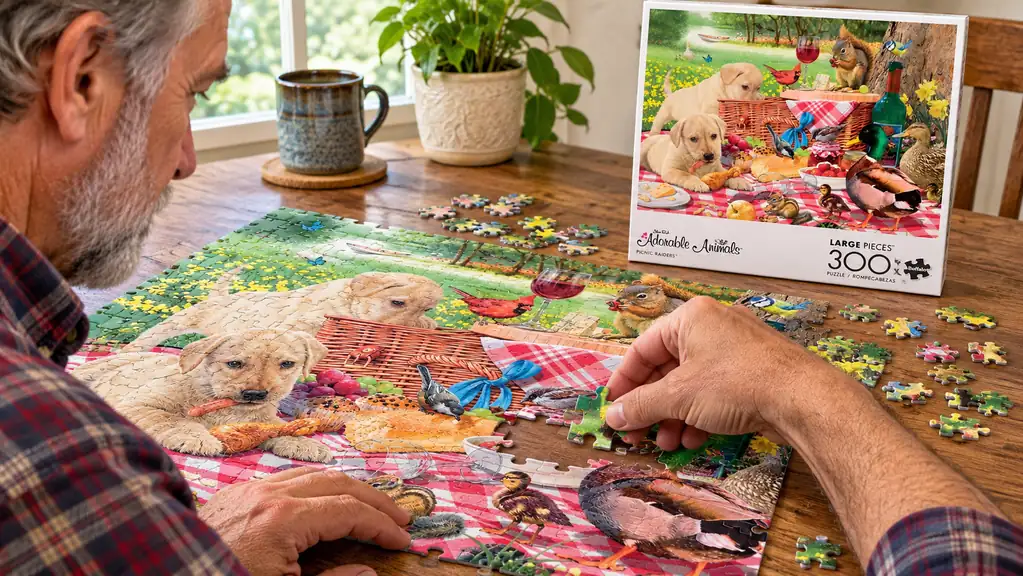
What the 300 Large Pieces Actually Feel Like
The listing calls them large sturdy pieces, and that is accurate in the hand. They are easier to see, easier to pick up, and easier to place. That sounds like marketing language until you watch someone with arthritis try to work a small piece. The difference is not subtle. June could hold a piece between her thumb and forefinger without pinching hard. She could set it down and adjust it without knocking the whole section out of line.
June sorts into saucers. She takes the small plates out of her kitchen cabinet, sets three or four of them around the puzzle, and sorts by what is in the picture: a puppy on this plate, a bird on that one, a pile of pieces with nothing but grass on the third. On a standard puzzle that habit works against her, because a saucer holds maybe fifteen small pieces before they start to overlap into a heap. With this set, a saucer holds a handful of pieces and she can still see all of them at once. I did not expect the plate trick to be the thing that made the difference, but it was. She could look down and see six pieces instead of a jumble.
The puzzle is paper, not wood. The pieces have a standard jigsaw cut, and the finished puzzle is meant to be display-worthy according to the listing. I would not call it a keepsake puzzle. It is a good everyday puzzle that you can pass along without feeling like you are giving away something precious. That is a feature for a gift. You want the person to use it, not protect it.
The item weight is 8 ounces, which makes it easy to carry to an assisted living apartment or a hospital room or a vacation rental. The package type is standard, and the set includes the puzzle and a poster. The poster is the quiet hero. June could keep it in front of her instead of hunching over the box lid. If you have ever watched someone with neck or shoulder trouble try to read a box lid at arm's length, you know why that matters. The lid on this one went straight into the recycling pile and never came back out.
The Picture Is the Gift and the Problem
Picnic Raiders is a busy scene. The listing describes puppies, squirrels, colorful birds, and bright summer details. That is exactly the kind of picture that works for June. She likes animals. She likes a picture she can talk about. The cute characters give her something to point at and name, which makes the puzzle feel personal instead of generic.
The puppies did most of the work, if I am being honest. June is a dog person and always has been, and she spent the first ten minutes just looking at the picture before she touched a piece. She picked out one puppy near the middle of the scene and started calling it the ringleader, and every time she found a piece with part of that face on it she announced it to the room. That is not a small thing for a woman who spends a lot of afternoons alone in a one-bedroom apartment. The picture gave her something to narrate. A landscape would not have done that.
The same busy picture is why an experienced puzzler may find this too easy. There are only 300 pieces, and the pieces are large. The picture gives you a lot of clues. A practiced adult can sort by animal, by background, and by border and move through it quickly. That is not a flaw in the product. It is a mismatch with the wrong buyer. If you want a puzzle that takes a week of evenings, this is not that puzzle.
The age recommendation is 14 years and up. That is worth reading twice if you are thinking of this for a younger grandchild. The pieces are large, but the manufacturer still lists it for older kids and adults. I would not hand it to a 4-year-old and assume it is a toddler puzzle. The picture may look young, but the product is not marketed as a preschool toy.
The best compliment I can give a puzzle for older hands is that my mother stopped asking me to turn the pieces over.
What Nobody Tells You About Large-Piece Puzzles
Large pieces are easier on the hands, but they are not automatically easier on the table. A 300-piece puzzle with large pieces still needs room to spread out. I would not try this on a TV tray or a lap desk. June has a small dining table in her apartment, and it took most of it. If the person you are buying for has a crowded coffee table and no place to leave a puzzle out, that is a practical problem no amount of large-piece engineering solves.
The second thing nobody tells you is that a poster can be a help and a nuisance. June loved it. Ron found it one more thing to keep track of. If the person you are buying for likes a reference, the poster is a real bonus. If they prefer to work from the box or from memory, it will end up under the sofa. Neither reaction is wrong. It just depends on the person.
The third thing is that 300 pieces is a specific kind of gift. It is not a challenge gift. It is a companionship gift. It is for someone who wants something to do with their hands while the television is on or while a grandchild is in the room. If you are buying for a person who brags about finishing a 2,000-piece puzzle over a weekend, this will feel too light. Buy the 1,000-piece version and accept that you may be buying frustration for someone else.
How It Held Up Over Several Visits
The puzzle is made in the United States with premium board and recycled materials, according to Buffalo Games. In our use, the pieces held their shape. We did not have corners peeling apart or tabs bending. The finished puzzle looked neat enough to leave out, which is saying something because June is particular about her table. The manufacturer lists a 90-day warranty against manufacturer defects. I did not need it, but I like seeing it on a product that is going to be handled a lot.
The one moment of drama came on a Tuesday evening in her second week with it. She set her tea down on the far corner of the table, and while she was reaching for a piece she caught the edge of the cup with her sleeve. Nothing spilled, but the poster got nudged and folded along one side, and a few border pieces slid onto the seat of the chair. It took us about two minutes to get everything back, and nothing was torn. If the cup had gone over, the paper pieces would not have survived it. That is worth knowing if the person you are buying for keeps a drink within reach, which most people do. A shallow tray under the drink, or a spot on the side table, solves it.
The other wear point was the poster, which got folded and unfolded and set down near the tea. That is not a product defect. It is life. If you are buying this for someone who likes to keep things tidy, you may want to put the poster in a sleeve or clip it to a board. That is a small thing, but it is the kind of small thing that decides whether a gift stays out or goes in a closet. The pieces themselves went back in the box and the box held up fine, which is more than I can say for some puzzle boxes I have carried home.
What I Liked
- Large pieces are easier for older hands and mild arthritis.
- The included poster gives a readable reference beside the table.
- 300 pieces is a manageable project for short visits.
- The item weighs 8 ounces, so it is easy to carry.
- Made in the United States with premium board and recycled materials, per the listing.
- 90-day warranty against manufacturer defects.
Where It Falls Short
- Too easy for experienced puzzlers.
- 300 pieces may be finished in one or two evenings.
- The cute animal scene will not suit every adult.
- It takes up a table, despite the large pieces.
- The 14-and-up age recommendation rules out young grandchildren.
Who This Is For
This is for the grandparent who likes a quiet project but does not want to be defeated by it. It is for someone with mild arthritis or weak grip who still wants to use their hands. It is for a person who likes animals and a picture they can talk about. It is also for the gift giver who wants something that can be done during a visit, not something that requires a tutorial.
It is a good fit for June. She is 88, she lives in a smaller apartment, and she likes a project that comes with a clear finish line. The Buffalo Games puzzle gave her something to do while I sat with her, and it gave us something to talk about that was not the weather or her medication. That is worth more than the puzzle itself.
Who Should Skip It
Skip it if the person you are buying for is an experienced puzzler who wants a challenge. Skip it if they have a small table and no place to leave a puzzle out for a few days. Skip it if they dislike cute animal scenes or prefer a more adult image. Skip it if you are shopping for a child under 14, because the manufacturer lists this for 14 years and up.
Also skip it if you want a wooden keepsake puzzle. This is a paper puzzle, and it is built like a paper puzzle. That is not a criticism. It is just the right tool for a different job. If you want a puzzle that becomes a family heirloom, you are shopping in a different category.
How It Compares With Other Large-Piece Puzzles
If you are weighing this against a Ceaco large-piece puzzle, the decision usually comes down to piece count and picture. Both brands make large pieces that are easier to handle. Buffalo Games gives you 300 pieces and a poster in this set. Ceaco may offer a different piece count and a different image style. I would choose based on the person's patience and taste, not on brand loyalty. A puzzle is a personal gift, and the picture matters as much as the piece size.
The other comparison is with a standard 500-piece puzzle. A 500-piece puzzle is still manageable for many older adults, but the pieces are smaller. If the person you are buying for has good eyes and good hands, 500 pieces may be a better challenge. If they have arthritis or trouble seeing the pieces, the large 300-piece set is the safer choice. That is the tradeoff in one sentence: fewer pieces, bigger pieces, less strain, less challenge.
If the person you are buying for needs large pieces, this is the one I would start with.
Buffalo Games lists 300 large pieces, a poster, and a beginner skill level. June could use it on her own, and that is the test that matters.
Amazon Check Today's Price on Amazon →