
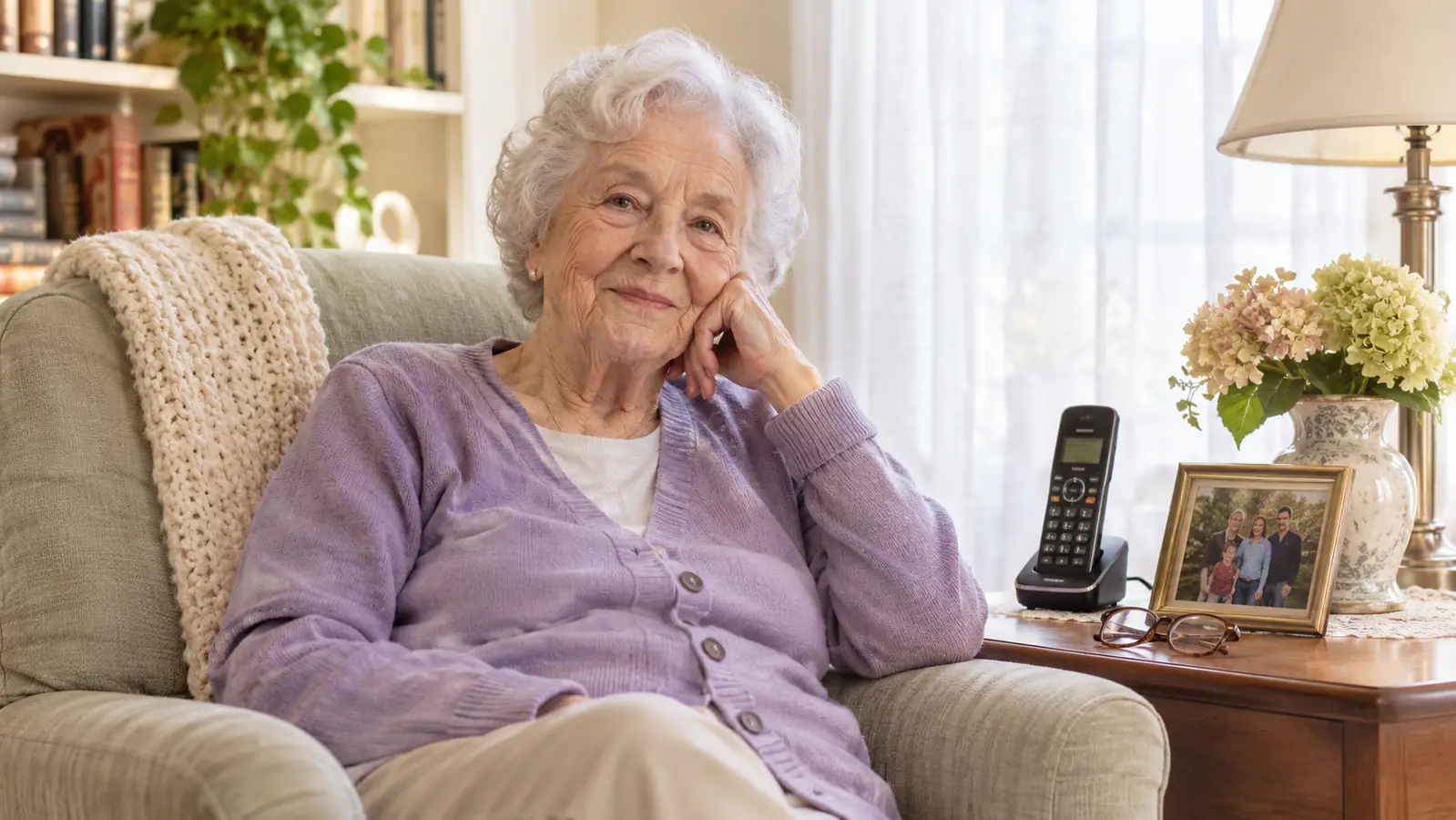
My mother is 88 and lives in an assisted living apartment about twenty minutes from my house in Lancaster, Pennsylvania. She has mild arthritis in both hands, and last winter she quietly stopped answering her phone. Not because she could not hear it. Because by the time she worked the handset out of the cradle and found her reading glasses, whoever called had given up. The phone she had was nine years old, a slim cordless thing with a screen the size of a postage stamp, and the buttons had worn smooth in the middle where her thumb landed. When I asked her about it she said, 'It is easier to just let it ring.' That sentence is the reason a Panasonic Cordless Phone KX-TGU432B now sits on her end table, and the reason three other big-button phones spent a week in my trunk before I returned them.
So here is the short answer before the long one. For most families in this situation, the Panasonic is the better pick. It announces callers out loud, it comes with two handsets so one can live by the recliner and one by the bed, and the buttons and the 2.1 inch display are sized for hands that are not what they used to be. The alternatives win on two honest points. A plain corded phone never needs charging, and a phone with fewer features has fewer menus for your parent to ignore. If your father or mother will not use caller ID or an answering machine, buy the simpler phone. I would not talk you out of it.
| Panasonic KX-TGU432B | Other big-button phones (VTech and similar) | |
|---|---|---|
| Handsets in the box | Two cordless handsets, so one can live by the chair and one by the bed | Often a single handset, some sets come with two |
| Display and buttons | 2.1 inch display with big buttons | Large too, that is the whole point of the category |
| Who is calling | Talking caller ID says the name out loud | Only on the models that advertise it |
| Finding it in the dark | Built-in flashlight | Rarely included on the models I compared |
| Nuisance calls | Call block built in | Varies by model, check before you buy |
| Answering machine | Digital answering system with 17 minutes of recording | Some have one, some do not |
| Volume | Volume boost for hard of hearing | A handset volume control, not always a boost |
| Charging | Battery powered, 10 hours of talk time and 5 days of standby, 4 AAA batteries included | A corded model never needs a cradle or a battery |
| Menus to learn | More settings than my mother will ever touch | The plainest models ask almost nothing of you |
| Best for | A parent who moves between the living room and the bedroom | A parent who wants one phone in one spot and nothing to charge |
Where the Panasonic Big Button Phone Wins
Start with the caller ID, because that is the feature that changed the most in our house. Talking caller ID says the name out loud before my mother reaches the phone, so she knows whether the walk to the end table is worth it. Her sister in Erie calls every Tuesday morning at ten. Her grandchildren call when they remember, which is more often than I expected. The recorded voice does not care that her reading glasses are in the other room, and that turned out to be the whole problem with the old phone. She was not refusing calls. She was refusing the small ceremony of finding her glasses, reading a tiny screen and deciding whether to bother. The first Tuesday after we set it up, I happened to be standing in her kitchen when the phone announced her sister's name. My mother looked up, said 'that is Jean,' and answered on the second ring. I have not stopped thinking about that since.
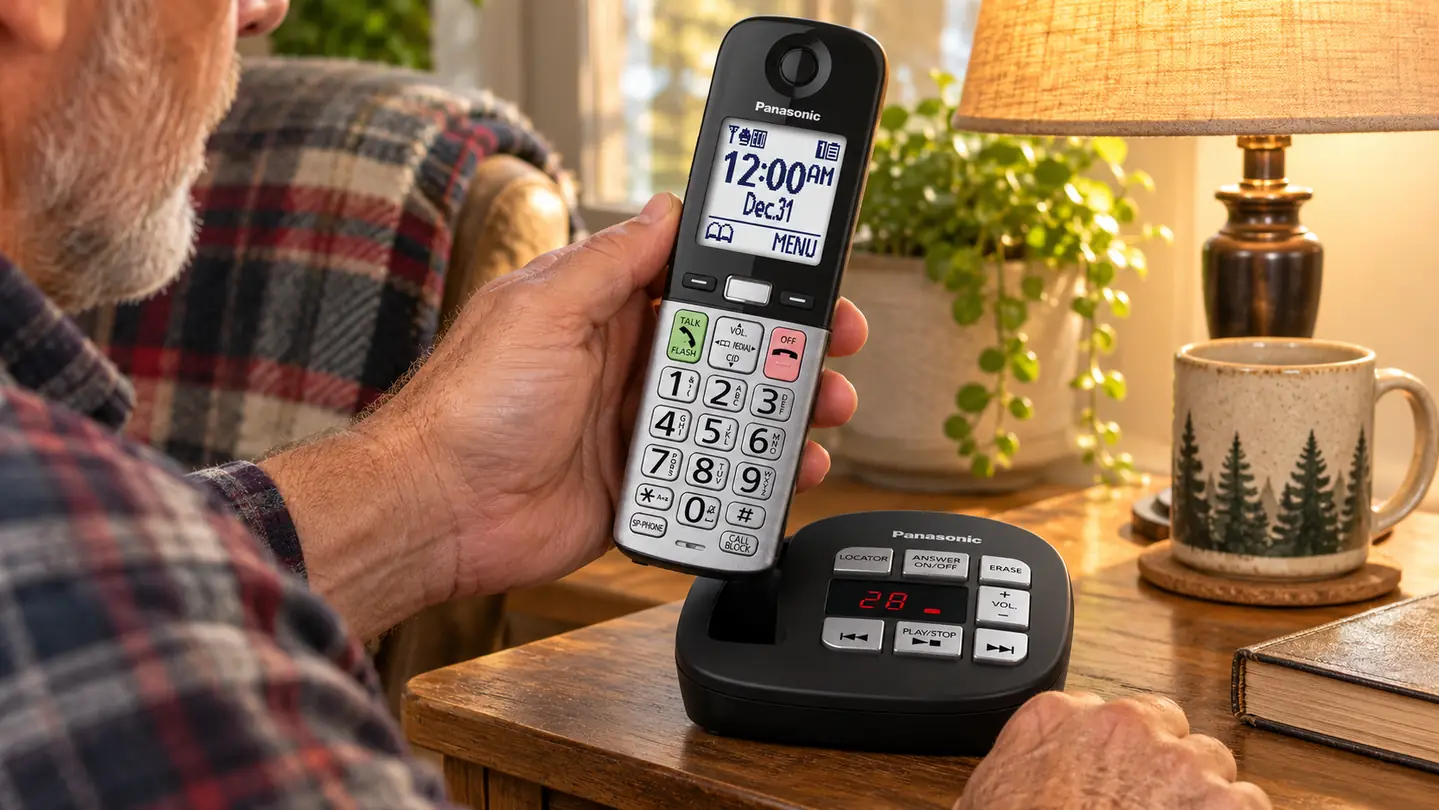
The second handset is the quiet hero of the set. My mother's apartment is two rooms and a hallway, and a phone that stays in the living room means she is up and moving every time it rings, which is exactly the thing her hands and her knees do not need. One handset sits by her chair and one sits on the nightstand. The flashlight matters more than I expected, since she is up at two in the morning and does not want to turn on a lamp to find the bathroom. Call block took one afternoon, and now the recorded sales calls do not reach her at all. The digital answering system holds 17 minutes of messages, which is well past the point where she stops listening anyway. And the volume boost is the setting I adjust most, because she will not admit the television is louder than it used to be, but about once a month she asks me to make the phone a little louder.
Where the Alternatives Win
Now the honest part. A corded phone has one advantage I could not argue with. It is always ready. It never ends up in the kitchen because someone set it down, and it never runs out of power in the middle of a call. The Panasonic is battery powered, with four AAA batteries in the box, and it is rated for ten hours of talk time and five days of standby. That is plenty for the way my mother uses a phone. But plenty depends on her setting it back in the cradle, and some weeks she does not. We lost a handset under a newspaper for two days in April. I called it from my cell phone, heard it ringing somewhere in the living room, and we finally dug it out from under the Sunday crossword. A corded phone cannot be misplaced. There is a lot to be said for a phone that lives in one spot and stays there.
The second concession is menus. The Panasonic has more settings than my mother will ever touch, and every one of them is a small chance for confusion. I spent two evenings on the answering system, once to record the greeting and once to change it because she decided my voice sounded too formal for her apartment. There is a whole setup routine in the little book, and half of it exists for people like me, not for her. A plainer phone asks almost nothing of you. You pick it up, you dial, that is the entire relationship. Some people would rather do without a phone altogether than sit through a tutorial, and for them the simpler alternative is genuinely the kinder choice. If your parent has memory issues, that is not a small consideration either, because a menu they cannot remember is a daily reminder that they cannot remember it.
The feature that ended the missed calls was the voice, not the buttons
Talking caller ID says the name out loud, and a second handset puts one in the bedroom. This is the phone my mother answers again.
Amazon See the Panasonic KX-TGU432B on Amazon →What Two Handsets Actually Change
People shop for big buttons and forget about rooms. A phone in the living room is useless when the call comes while your parent is in bed, and a phone by the bed is useless when they are watching television in the afternoon. Two handsets solve a geography problem, not a technology problem. My mother keeps one on the end table next to her chair and one on the nightstand, and she has not missed the Tuesday call since March. That is six months of Tuesdays, which is not a scientific sample but is enough to convince me. The base charges both handsets, so there is no second cradle to find room for on a nightstand that already holds a lamp, a clock and a photo of the grandkids.
The second handset also lets me join a call when I am visiting. I pick up the other handset, say hello, and suddenly the three of us are talking instead of me shouting from the kitchen. Three way calling is in the settings too, and we used it once to bring Ron in from the garden so he could hear the news from her sister. That is not a feature I would have studied on the box, but it has earned its place. The favorites key is the other one worth knowing about. It flashes when there is an incoming or missed call, so even from across the room she can see that something happened while she was in the bathroom. I saved her sister, her doctor and my number to it, which means the three calls that matter most are one button away.
The First Week, Honestly
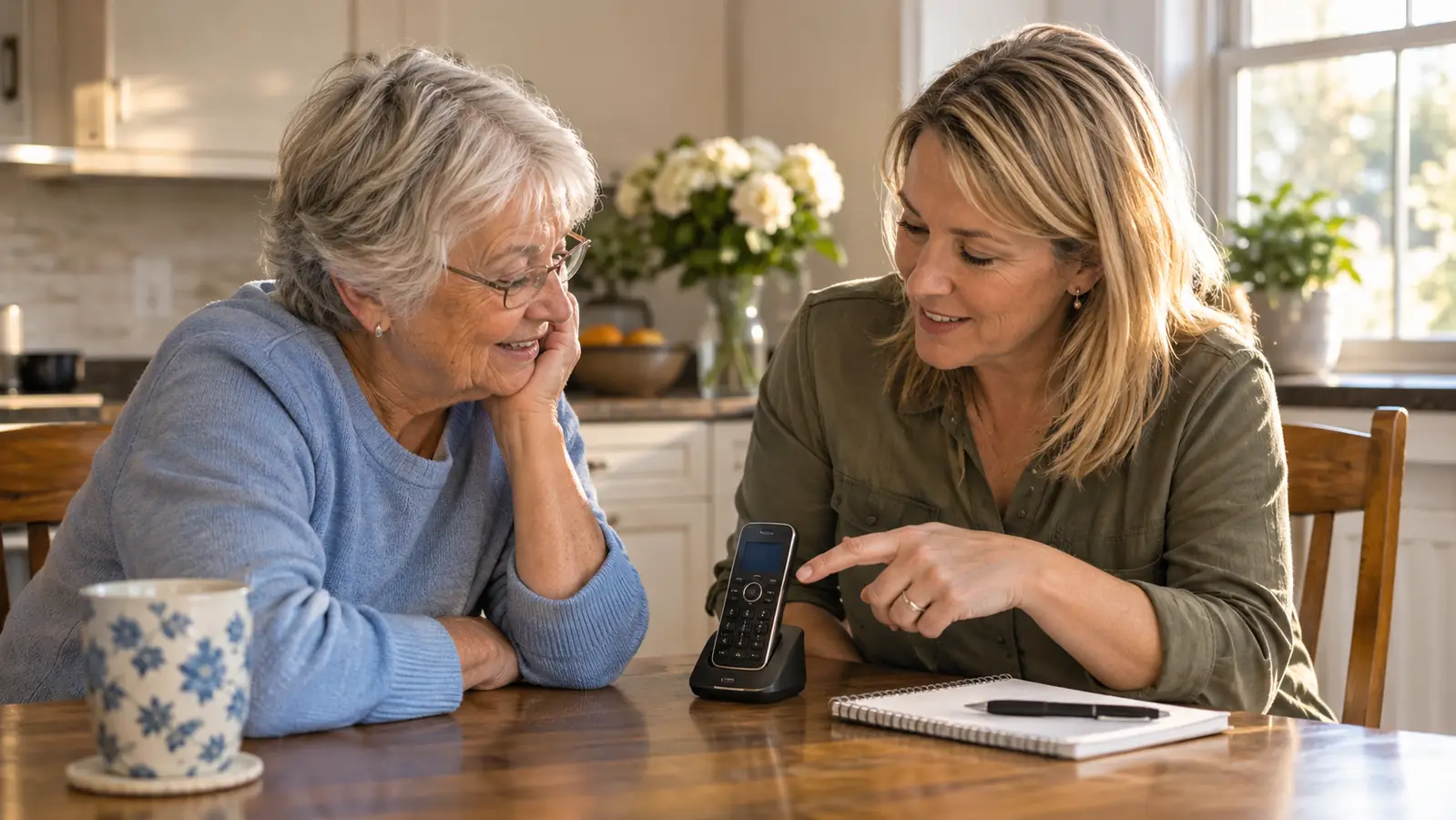
Setup took about twenty minutes, most of it spent with the little instruction book. The four AAA batteries were already in the box, which saved me an errand. I plugged in the base, set the date and time, recorded a greeting because my mother did not want to do it, and saved her sister's number to the favorites key. That key flashes when there is an incoming or missed call, and it sounds like a small thing until you watch someone's face when they realize the phone is telling them something instead of waiting to be asked. The display is 2.1 inches, which does not sound large on paper. On an end table, at the distance a person actually sits from a phone, it is the difference between reading a name and guessing at one.
The first three days were rough in an ordinary way. She let it ring twice because she had not yet connected the voice to the idea that she should pick up. She set the handset down in the kitchen once and we found it the next morning. She asked me three times whether the flashlight would run the battery down, and I told her the truth, which is that I did not know and that the batteries are easy to change. On the fourth day she called me to say the phone had announced a call from her doctor and she had answered it herself, and she sounded like a woman reporting a small victory, which it was. By Friday she was answering again. That is the part nobody mentions about a new phone for an 88 year old. The hardware works on day one and the habit takes about a week.
By Friday she was answering again. The hardware worked on day one. The habit took a week.
What My Mother Uses and What She Ignores
Four things get used every day: the big buttons, the volume boost, the talking caller ID and the flashlight. Everything else is mine to manage. I set the call block once and she has never opened that menu. The three way calling sits there untouched. The option to add a range extender exists for houses bigger than her apartment, and I have not needed it. Even the answering system is effectively mine, because I am the one who changes the greeting when she gets tired of hearing it. She listens to messages. She does not record them.
This is where I disagree with the reviews that count features. A long list is not a benefit if your parent never opens the menu. What matters is whether the two or three things they touch every day work without help. For my mother that is the buttons, the volume and the voice that says who is calling. The rest is for me, on the day something needs changing. When I bought the phone I made a small list on the back of an envelope: who is calling, can she hear it, can she reach it, can she find it in the dark. The Panasonic answered four out of four. It also brought along six things she will never use, and I have made my peace with that.
Who Should Buy Which
Buy the Panasonic if your parent still lives independently or semi-independently, uses a landline on purpose, and has trouble with small buttons, small screens or low volume. It is also the right call if they move between two rooms in a day, because the second handset removes the walk. VTech makes good big-button phones too, and if your mother already has one she likes, leave it alone. Never replace a working phone as a surprise. A gift that rearranges someone's routine is not a kindness, it is homework.
Buy a simple corded alternative if the phone will sit in one spot, if menus would go unused, or if a cordless handset would end up lost in a drawer. Buy it, too, if the person in question has memory issues and you want zero charging routine in their day. And whatever you choose, if it is a gift, buy it two weeks before you plan to give it. Set it up, record the greeting, save the important numbers, and walk through it once in person. Handing someone a box and a manual is not a gift. Handing them a phone that already works is.
One by the recliner, one by the nightstand, and a voice that says who is calling
Two handsets, a flashing favorites key, a flashlight and talking caller ID. This is the phone that got my mother answering again.
Amazon Check it out on Amazon →